A stay in nature, with comfort.
Domes, shepherd's huts, luxury tents, cabins, mobile homes and treehouses in Hungary. If you would like to sleep in one, you will find inspiration here. If you would like to build one, you can start planning here.
What brings you here?
Six ways to sleep in nature, with hotel comfort
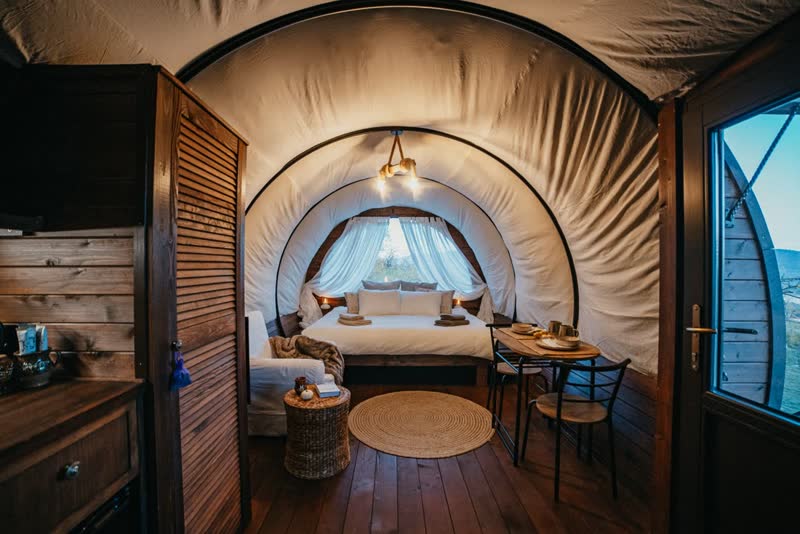
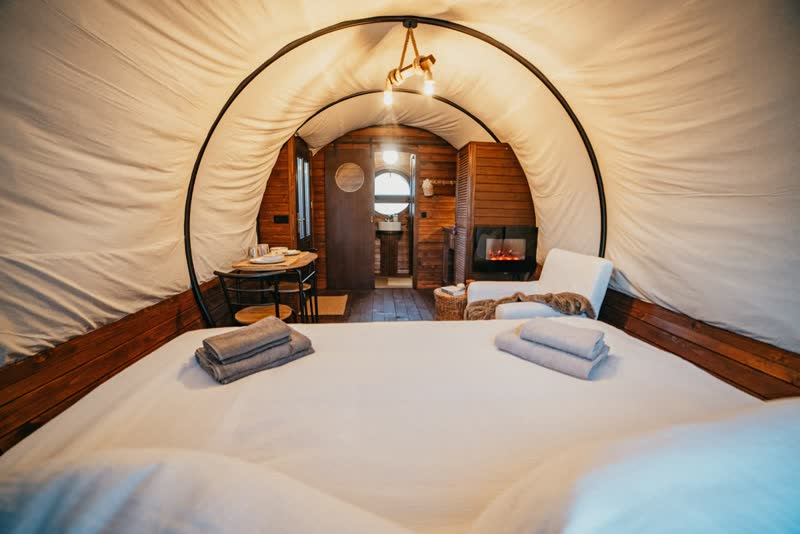
The essence of glamping is that you sleep in a small, unusual building in a quiet, beautiful place, and you still have your own bathroom, heating and a good bed.
Luxury tent
A canvas structure on a timber floor, the quickest type to install.
Geodesic dome
A dome built from triangles, with a large glazed surface, even for four-season use.
Glamping shepherd's hut
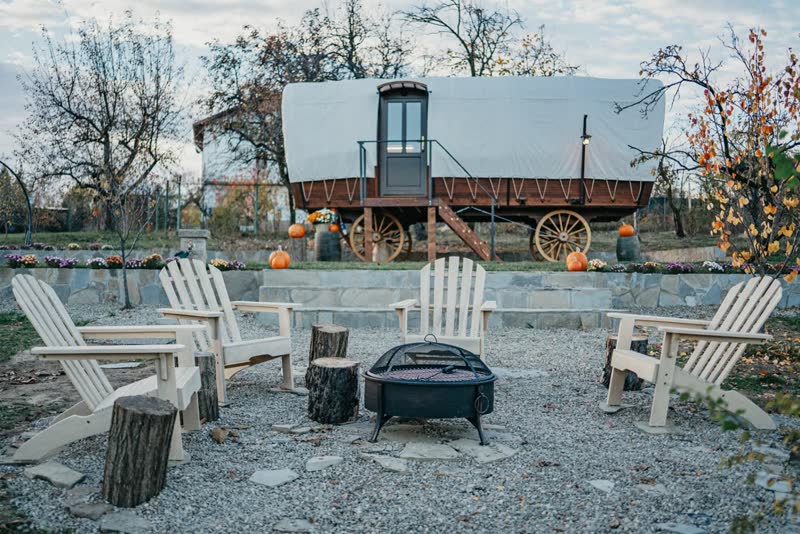
A wheeled, movable unit, often with a lighter permitting burden.
Wooden house, cabin, A-frame
A small lightweight-structure house, the closest to a conventional holiday home.
Mobile home
A factory-finished, transportable unit. Quick installation, predictable cost.
Treehouse
Among the trees, above the ground. The greatest experience, the most planning.
Get notified about new, unusual places to stay
At most one e-mail a month, with selected places. You can unsubscribe at any time.
Looking for glamping accommodation?
We are putting together our own, personally visited selection right now: we want to recommend places where we know what the guest gets there. Until that is ready, we do not recommend anywhere we have not been. Tell us what you are looking for, and we will send you the list as soon as it is done.
In the meantime: in the Knowledge Base we have written up what works in Hungary today and is well rated, by name and from named sources. It shows which types you can choose from today, and which ones are still scarce in Hungary.
Send me the accommodation selection
Tick which type interests you, and we will send the list by e-mail.
What is glamping, beyond the mood?
It comes from the compound “glamorous camping”: private, comfortable accommodation in beautiful natural surroundings. In Hungary the genre is still young, so it is worth knowing its practical side too.
How is it different from a campsite or a holiday home?
- Few units in one place, often just one, far apart from each other. Privacy itself is the product.
- The units are small (typically under 50 m²) but fully equipped: bathroom, heating, cooling, a good bed.
- The experience comes mostly from the location: forest, water, views, silence, a dark sky.
What does the ideal site look like?
- Natural enclosure: a belt of woodland, groups of trees, an “embrace” of the terrain. Not in the middle of a field.
- Water nearby (a stream, a lake) is an advantage; it does not have to be within the plot.
- Low noise and light pollution, with no view in from neighbours, especially with glazed surfaces.
- Stable ground that does not get waterlogged, flat or gently sloping, with a road that is passable all year.
- Utilities are an advantage but can be replaced: a well, a sealed wastewater tank, solar panels.
- There should be things to do nearby: hiking, food and wine, spa. This is what gives stable occupancy.
Four-season operation: the technical pitfalls
- Heating and cooling: a heat pump, air conditioning, an electric fireplace or a wood-burning fireplace.
- With large glazed surfaces, humidity and condensation are the main enemy: heat-recovery ventilation and a humidity sensor are needed.
- Against summer overheating: a UV-filtering layer, external or motorised shading, timed pre-cooling.
- Without extending the season the return deteriorates significantly, which is why a sauna, a hot tub or a heated unit is often not a luxury but a business question.
Permits and registration, in broad strokes
- The first step is always the local regulation: the zoning of the plot and the local building code decide what can be built.
- It is worth consulting the municipality and the chief architect early. A supportive municipality saves a lot of time.
- Avoid areas at risk of flooding or waterlogging, and heavily restricted nature conservation areas.
- To operate, an accommodation registration and NTAK registration (the Hungarian national tourism data centre) are required. The exact form (e.g. other accommodation or campsite) depends on the project.
- This is general information, not legal advice: a specific plot always needs an individual assessment.
Operation in practice
- Sales: your own website with direct booking (better margin), alongside Airbnb and Booking for visibility.
- Arrival: a smart lock or key safe, automatic messages to the guest.
- Extra revenue: breakfast basket, romantic package, late check-out, activities.
- For cleaning, plan half a working day per guest changeover. This is a planning estimate, not measured data: it depends on the size of the unit and on whether there is a hot tub and a sauna, because their water treatment and checks are a separate task.
Download the 20-page sample project as a gift
A complete geodome glamping concept from GlampingGuide: ideal site, technical content, operation, calculation logic.
This section tells the essentials. If the market background interests you too, there is a series of articles on it in the Knowledge Base: what glamping is, why there is demand for it, where the world, Europe, the region and Hungary stand. Every number comes with its source, and where we have no source, it says so.
A glamping project outline in 8 steps
We go through the same 8 cornerstones that the GlampingGuide feasibility summary is built from. At the end you get a preliminary assessment and order-of-magnitude figures.